Alzheimer’s Combination Therapy: The 2026 Shift
For years, the “holy grail” of Alzheimer’s research was a single drug that could cure the disease. In 2026, we’ve realized the truth is more complex: Alzheimer’s is a multi-front war, and we need a multi-front strategy.
The most significant shift in clinical practice this year is the move toward Combination Therapy—specifically, pairing “Amyloid Cleaners” with “Cellular Compactors.”
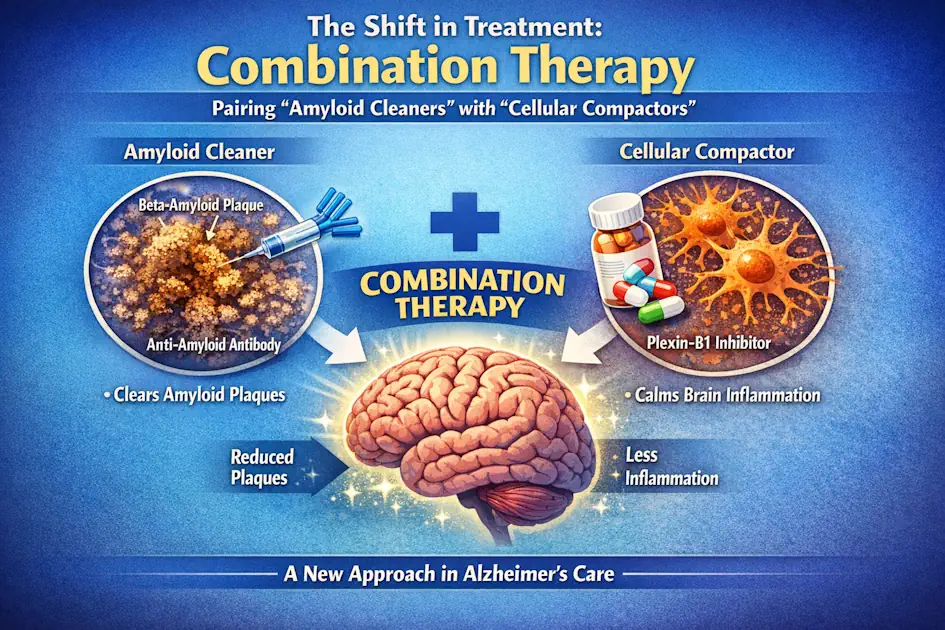 Figure 1. Combination Therapy for Alzheimer’s (2026) — The new “Precision Cocktail” pairs monoclonal antibodies that clear amyloid with Plexin‑B1 inhibitors that stabilize astrocytes and compact plaques. This dual‑path approach reduces ARIA risk and improves neurovascular protection, marking a major shift toward multi‑front treatment strategies.
🔬 The Synergy: Why One Drug is No Longer Enough
While anti-amyloid antibodies like Lecanemab (Leqembi) and Donanemab have been breakthroughs, they primarily slow decline by about 30%. The clinical bottleneck is that they act like a vacuum trying to clean a room while the trash is still being produced.
By adding a second drug—specifically a Plexin-B1 inhibitor (e.g., Pepinemab)—we stabilize the cellular support structure of the brain.
| Feature | The “Cleaners” (MABs) | The “Boosters” (Plexin-B1) | The 2026 Synergy |
|---|---|---|---|
| Primary Goal | Remove existing plaques | Protect cells & compact plaque | Clear waste & protect neurons |
| Mechanism | Extracellular Clearance | Astrocyte Modulation | Dual-Path Intervention |
| Safety Profile | Risk of ARIA (swelling) | Neurovascular Stability | Reduced ARIA Risk Profile |
🧪 The “Sequential Cocktail” Protocol
One of the most exciting protocols emerging in April 2026 is the “Pre-Treat and Clear” strategy. This sequence is designed to maximize safety for seniors with fragile blood-brain barriers.
- Phase 1: Compaction (Months 1–4): Patients start with a Plexin-B1 modulator to “corral” diffuse (fluffy) amyloid into dense, less-toxic bundles.
- Phase 2: Clearance (Months 5+): Only once the plaque is compacted is the anti-amyloid antibody introduced.
Research Insight: This sequence significantly reduces the inflammatory “surge” that often triggers ARIA-E (edema) during the initial clearance phase.
🔬 Precision Thresholds for Treatment
In my current audit of combination trials, we use specific Biomarker Thresholds to determine treatment eligibility:
- Amyloid Load (PET Scan): High-density loads prioritize Phase 2 clearance.
- p-tau217 Ratio: Success requires a baseline ratio of: \(\frac{p\text{-tau217}}{\text{non-p-tau}} \geq 0.06\)
- Genetic Profiling: Using APOEε4 status to adjust titration speeds.
📖 Clinical Glossary
- MABs: Monoclonal Antibodies (the plaque “cleaners”).
- ARIA: Amyloid-Related Imaging Abnormalities (brain swelling or bleeding).
- Plexin-B1: A protein that, when inhibited, allows astrocytes to manage plaque effectively.
- Astrocyte: Star-shaped glial cells that maintain the blood-brain barrier.
📚 Clinical Citations
- PMC11258156: Alzheimer’s Disease: The Move to Combination Therapies (2026).
- SciTechDaily (2026): Breakthrough Drugs: Rewiring the Brain Instead of Just Clearing Plaques.
- DZNE (2026): Plaque Compaction and Neurovascular Protection in Combination Protocols.