

The New Food Pyramid and Food Prices: What Families Need to Know

The New Food Pyramid, Keto, Carnivore, and Rising Food Prices: A Family‑Centered Guide
Families are hearing about a “new food pyramid” that flips the old model upside down — placing protein and healthy fats at the base, with less emphasis on grains and sugars. Keto and carnivore diets fit into this model, but today’s food prices make high‑protein eating difficult for many households. This guide helps families understand the new pyramid, compare diet styles, and make realistic, budget‑friendly choices.
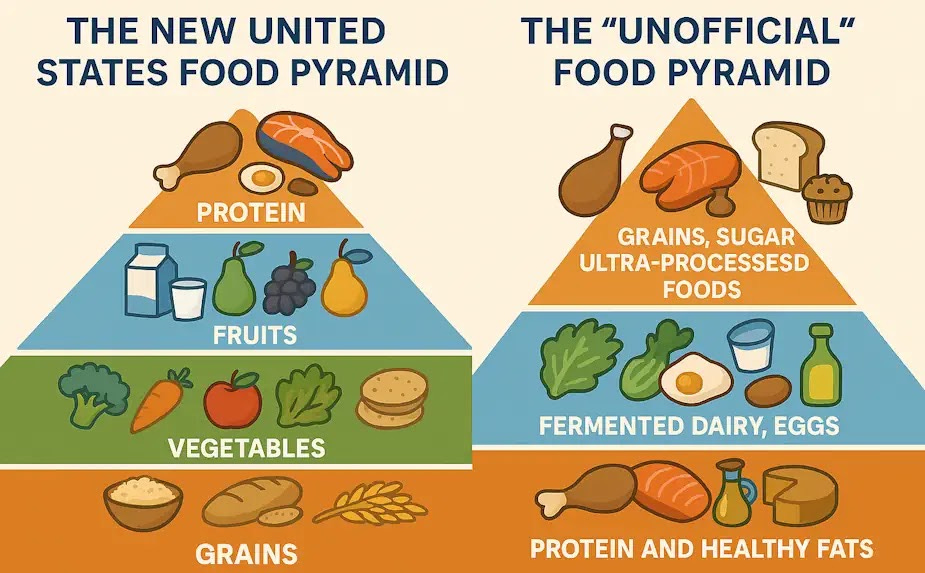
Comparison of the official and unofficial United States food pyramids, illustrating dietary guidelines and recommendations.
Introduction
Nutrition guidance is undergoing a major shift. For decades, Americans were taught to build meals around grains, fruits, and low‑fat foods. But a growing body of metabolic‑health research has challenged that model, leading to a new, alternative “food pyramid” that places protein and healthy fats at the foundation.
This modern pyramid aligns with low‑carb, keto, and carnivore eating patterns — all of which emphasize satiety, blood sugar stability, and nutrient density.
But there’s a real‑world barrier: food prices.
High‑protein diets require meat, eggs, dairy, and whole foods that have risen sharply in cost. Families want to eat healthier, but their grocery budgets are stretched thin.
This article breaks down:
What the new low‑carb food pyramid actually is
How keto and carnivore fit into it
Why food prices make these diets challenging
Practical strategies families can use
How to communicate effectively with healthcare providers
Key Points
The new food pyramid prioritizes protein and healthy fats, not grains.
Keto and carnivore diets are built on this model but are more restrictive.
Rising food prices make high‑protein diets harder for families to follow.
Blended, flexible nutrition strategies are more realistic for most households.
Families benefit from understanding the strengths and limitations of each diet style.
H2: What Is the New Food Pyramid?
The modern low‑carb food pyramid is not an official government guideline. Instead, it’s a metabolic‑health‑driven model promoted by clinicians, researchers, and nutrition educators who focus on insulin resistance, obesity, and chronic disease prevention.
H3: What It Looks Like
Base (largest portion):
Protein (meat, eggs, fish, poultry)
Healthy fats (olive oil, butter, avocado, animal fats)
Middle:
Non‑starchy vegetables
Fermented foods
Low‑sugar dairy
Top (smallest portion):
Fruits (especially berries)
Nuts and seeds
Minimal grains
Minimal sugars
Why This Model Exists
Low‑carb researchers argue that:
Protein increases satiety
Healthy fats stabilize energy
Reducing grains lowers blood sugar spikes
Whole foods reduce inflammation
Section Key Points
This pyramid flips the traditional model.
It emphasizes nutrient density over volume.
It aligns with keto and carnivore principles.
Keto and Carnivore — Where They Fit in the New Pyramid
Keto Diet
The keto diet is a high‑fat, moderate‑protein, low‑carb approach.
How Keto Fits the New Pyramid
Uses the same protein‑and‑fat foundation
Limits grains and sugars
Allows low‑carb vegetables
Includes dairy, nuts, and seeds
Benefits Often Reported
Appetite control
Reduced sugar cravings
Stable energy
Challenges
High cost of meat, dairy, and nuts
Harder for families with mixed dietary needs
Carnivore Diet
Carnivore is the most restrictive version of the new pyramid.
How Carnivore Fits
Base is exclusively animal protein and fat
No fruits, vegetables, or grains
Very simple but very expensive
Benefits Often Reported
Simplicity
Eliminates processed foods
Challenges
Cost
Limited variety
Difficult for children and families
Comparing the Three Models
New Food Pyramid
Flexibility: High
Cost: Moderate
Family Friendly: High
Variety: High
Best For: Families needing balance, budget awareness, and long-term sustainability.
Keto Diet
Flexibility: Medium
Cost: High
Family Friendly: Medium
Variety: Medium
Best For: Adults focused on low-carb, higher-fat eating with planning.
Carnivore Diet
Flexibility: Low
Cost: Very High
Family Friendly: Low
Variety: Low
Best For: Highly motivated individuals; not ideal for families or tight budgets.
Section Key Points
Keto and carnivore are subsets of the new pyramid.
The new pyramid is more flexible and affordable.
Restrictive diets increase grocery bills.
The Real‑World Problem — Food Prices Are Rising
Families want to follow healthier eating patterns, but the cost of:
Meat
Eggs
Dairy
Fresh produce
Whole foods
…has risen dramatically.
Why This Matters
The new food pyramid relies heavily on:
Protein
Healthy fats
Whole foods
These are the most expensive categories in today’s grocery market.
Zero‑Volume Keywords (
1. “budget‑friendly low‑carb pyramid strategies”
Try 50 Low Carb Cheap Meals (for Keto on a Budget) - Whole Lotta Yum
2.“family grocery inflation nutrition planning”
19 Ways to Eat Healthy on a Tight Budget
3. “affordable protein prioritization guide”
10 Cheap Protein Sources and How to Add Them to Your Diet - GoodRx
4.“healthy eating on restricted budgets 2025”
Nutrition on a Budget | Nutrition.gov
5.“low‑cost keto alternatives for families”
6.“nutrient density on a tight budget”
The Smart Shopper’s Guide: How to Prioritize Nutrient-Dense Foods on a Tight Budget – Frugalsquirrel
Practical Strategies for Families
1. Use Affordable Protein Sources
Eggs (sometimes cheaper from a local farmer)
Canned tuna
Chicken thighs
Ground turkey
Frozen fish
2. Mix Diet Styles
Families don’t need to be strictly keto or carnivore.
A blended approach is more realistic.
3. Use Frozen and Canned Produce
Still nutritious, far cheaper.
4. Build Meals Around Sales
Weekly ads can cut costs dramatically.
5. Buy In Bulk
Try Sam's, Costco or online.
Section Key Points
Flexibility is key.
Affordable substitutions still support health.
Families benefit from mixing diet styles.
Decision Tree — Which Diet Fits Your Family?
Start Here →
1. Do you want a flexible, affordable approach?
Yes → New food pyramid
No → Continue
2. Are you comfortable limiting carbs significantly?
Yes → Keto
No → New food pyramid
3. Do you want the simplest possible food list?
Yes → Carnivore
No → Keto or new pyramid
4. Is cost a major concern?
Yes → New food pyramid
No → Keto or carnivore
TermDefinition MacronutrientsProteins, fats, and carbohydrates — the main components of food. KetosisA metabolic state where the body burns fat for fuel instead of carbohydrates. SatietyThe feeling of fullness that reduces appetite. Insulin ResistanceA condition where cells respond poorly to insulin, affecting blood sugar. Nutrient DensityThe amount of nutrients per calorie in a food. Ultra‑Processed FoodsIndustrial foods high in additives, sugars, and refined grains.
H2: FAQs
1. Is the new food pyramid official?
No. It’s an alternative model used in metabolic‑health communities.
2. Is keto healthier than the new pyramid?
It depends on individual goals. Keto is more restrictive; the new pyramid is more flexible.
3. Why is carnivore so expensive?
It relies almost entirely on meat and animal products, which have risen sharply in price.
4. Can families follow keto on a budget?
Yes, but it requires careful planning and affordable protein choices.
5. What’s the most realistic approach for families?
A blended version of the new pyramid with affordable substitutions.
H2: Key Takeaways
The new food pyramid prioritizes protein and healthy fats.
Keto and carnivore are more restrictive versions of this model.
Rising food prices make high‑protein diets challenging.
Families benefit from flexible, blended approaches.
Affordable substitutions still support long‑term health.
📚 References
📘 U.S. Department of Agriculture. “Food Price Outlook, 2025–2026.” USDA Economic Research Service, 2026.
📗Stanford Prevention Research Center"What the 2025–2030 Dietary Guidelines Get Right—and Where They Fall Short | Nutrition"
📙 American Diabetes Association. “Nutrition & Wellness.” ADA Clinical Guidance,
📕 Cao, J., Lei, S., Wang, X., & Cheng, S. (2021). The Effect of a Ketogenic Low-Carbohydrate, High-Fat Diet on Aerobic Capacity and Exercise Performance in Endurance Athletes: A Systematic Review and Meta-Analysis. Nutrients, 13(8), 2896. https://doi.org/10.3390/nu13082896
📘 "Dr. Sofia Alvarez*Nutrition Science University, Spain. Journal of Nutrition Science ResearchOpen Access". Www.Omicsonline.Org, 2026, https://www.omicsonline.org/open-access/macronutrients-fueling-body-functions-health-and-balance-138524.html. Accessed 22 Jan 2026.
📗 Understanding the new Dietary Guidelines for Americans (2026). Available at: https://hsph.harvard.edu/news/understanding-the-new-dietary-guidelines-for-americans/ (Accessed: 22 January 2026).
📙 Food and Agriculture Organization. “Global Food Price Index Report.” FAO, 2025.
📕"Samantha Laine Perfas. Looking to build muscle? Lose weight? Need more protein, right? Probably not.". News.Harvard.Edu, 2026, https://news.harvard.edu/gazette/story/2025/11/looking-to-build-muscle-lose-weight-need-more-protein-right-probably-not/. Accessed 22 Jan 2026.
📘 Sun, Jia et al. “The effect of dietary carbohydrate and calorie restriction on weight and metabolic health in overweight/obese individuals: a multi-center randomized controlled trial.” BMC medicine vol. 21,1 192. 24 May. 2023, doi:10.1186/s12916-023-02869-9
📗 "Analyzing economic inflation's impact on food security and accessibility through econometric modeling". Www.Researchgate.Net, 2026, https://www.researchgate.net/publication/386378865_Analyzing_economic_
inflation's_impact_on_food_security_and_accessibility_through_econometric_modeling. Accessed 22 Jan 2026.